More Than a TB Screening: How a Portable Digital X-ray Saved the Life of a Nine Year-Old Boy in Rural Nasarawa
When the TB LON 1 & 2 outreach team arrived in Adogi community, a hard-to-reach settlement in Lafia Local Government Area of Nasarawa State, their primary objective was clear: identify people with tuberculosis (TB) early and connect them to treatment. What they did not anticipate was that the Portable Digital X-ray (PDX) would uncover a completely different life-threatening condition ultimately saving the life of a nine-year-old boy.
Like many children in rural communities, Saidu had been living with a persistent cough for several weeks. His parents believed it was a stubborn cold that would eventually resolve on its own. Access to specialized diagnostic services was limited, and travelling to a hospital would have required time and money the family could scarcely afford.
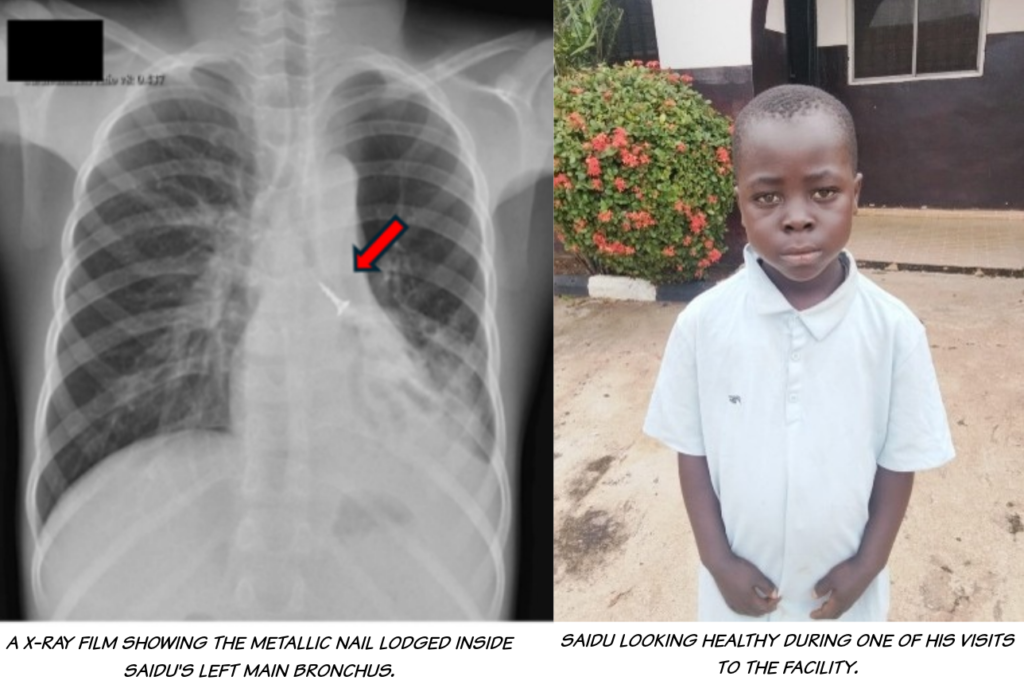
On the 15th of June 2026, during a TB LON 1 & 2 community outreach conducted by the TB LON project in Adogi community, Saidu’s parents brought him to the screening site. As part of the outreach, community members with symptoms suggestive of TB received free chest screening using a Portable Digital X-ray. The X-ray revealed a startling and unexpected finding. Instead of showing only signs consistent with pulmonary disease, the image clearly displayed a metallic screw nail lodged inside Saidu’s left main bronchus.
When the healthcare team questioned him, Saidu recalled swallowing a nail about four months earlier. Believing it had passed naturally, neither he nor his family realized it had instead entered his airway and remained in his lung. Left undetected, the foreign body could cause severe infection, lung damage, respiratory complications, or worse, even death.
Recognising the urgency of the situation, the outreach team immediately counselled Saidu’s parents and arranged an emergency referral to Bingham University Teaching Hospital, where specialists successfully removed the nail through bronchoscopy. After being discharged, upon returning to Lafia, the TB LON team followed up with bacteriological testing per the algorithm for a high CAD scoring X-ray such as Saidu’s. A sputum sample was collected and tested using GeneXpert. The test came back positive for drug-susceptible TB, and Saidu has since been enrolled on treatment.
Today, Saidu is on his way to a full recovery and has resumed his normal childhood activities.
“We thought it was just a cough. If KNCV had not brought that machine to our community that day, we might have lost Saidu. We thank God, and we thank KNCV Nigeria.” – Saidu’s Mother
The experience also left a lasting impression on the outreach team.
“We came to Adogi to find people with TB. Instead, we found a nail in a child’s lung and helped save his life. This is exactly why taking digital X-ray services into underserved communities matters.”
– KNCV Nigeria Radiographers, Khadija Ahmed and Finbarr Okoye.
While the Portable Digital X-ray was deployed to strengthen TB case detection, Saidu’s story demonstrates its broader value in diagnosing other health-related issues or conditions as well as improving access to essential diagnostic services in underserved communities.
This single encounter illustrates how donor investments in innovative community-based healthcare can yield benefits far beyond their original purpose through expanding access to life-saving diagnostics, facilitating timely referral and treatment and building community confidence in healthcare services: Stories like Saidu’s strengthen trust in community outreach activities, encouraging more people to participate in future screenings and seek care early.